|
|

 |
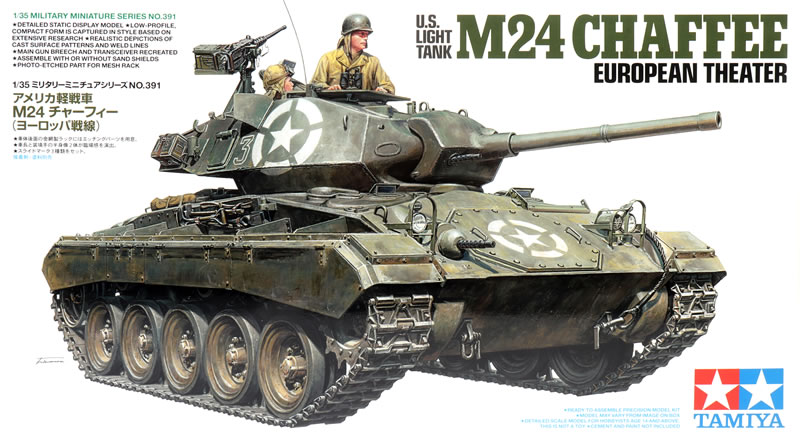
US Light Tank M24 Chaffee European Theatre
Tamiya 1/35 scale
Reviewed by Brett Green
Summary
| Stock Number and Description | Tamiya Kit No. 35391 - US Light Tank M24 Chaffee European Theatre |
| Scale: | 1/35 |
| Media and Contents: | Around 330 parts in dark green plastic; ten parts in clear; four polythene caps; one photo-etched part; markings for three vehicles. |
| Price: | TBA |
| Review Type: | First Look |
| Advantages: | Straightforward build; high level of detail; includes two torso figures for the turret. |
| Disadvantages: | |
| Recommendation: | Highly Recommended |

B a c k g r o u n d
The M24 Chaffee was developed by the United States during World War II to replace the ageing M3 and M5 Stuart light tanks. Although the Stuarts had proven reliable and mechanically robust, their light armour and 37mm gun were increasingly inadequate against modern battlefield threats. In April 1943, the U.S. Army initiated a new light tank programme that sought to combine improved firepower, mobility and crew efficiency in a vehicle that remained lightweight and easy to transport.
The result was the Light Tank M24, developed by Cadillac and armed with a compact version of the 75mm gun used in the North American B-25 Mitchell bomber. This weapon represented a significant improvement over the Stuart's 37mm gun, giving the new tank a much greater capability against enemy fortifications, soft-skinned vehicles and lightly armoured targets. The M24 also featured torsion-bar suspension, a wider track system and a more spacious three-man turret, greatly improving crew effectiveness and battlefield performance.
Production commenced in 1944, with more than 4,700 vehicles ultimately manufactured. The tank was officially named "Chaffee" after General Adna R. Chaffee Jr., often regarded as one of the founding figures of the U.S. Armoured Force.
The M24 first entered combat during the closing months of World War II. It saw service in the European Theatre from late 1944, where it quickly earned a reputation for reliability, speed and excellent cross-country mobility. While it was never intended to engage heavy German tanks directly, crews appreciated its improved firepower and agility compared to its predecessors. Chaffees were widely employed in reconnaissance, screening operations and infantry support roles.
Following the war, the M24 remained in service with the U.S. Army and many allied nations. It saw extensive action during the Korean War, where its mobility and firepower once again proved valuable despite the increasing prevalence of heavier enemy armour. The Chaffee was also exported to dozens of countries and served in conflicts around the world well into the 1970s.
Although eventually replaced by the M41 Walker Bulldog, the M24 Chaffee is widely regarded as one of the most successful light tanks of the Second World War, combining speed, reliability and firepower in a well-balanced and highly effective design.
Chaffee in 1:35 scale
This is not the first 1:35 scale M24 Chaffee to hit the market.
Italeri first released its M24 Chaffee in 1986. It was a very respectable kit for its time, and the mouldings received a welcome update in 2015 when new (mostly) individual-link tracks and additional detail parts were introduced as part of a collaborative venture between Tamiya and Italeri.
Please note that Tamiya’s new kit has nothing at all in common with these earlier releases.
Bronco came next with a couple of M24 Chaffee boxings from 2012 onwards. These were highly detailed and accurate but, speaking from experience, assembly is complex and fiddly.
Let’s see what Tamiya has to offer.
F i r s t L o o k
Tamiya's 1:35 scale M24 Chaffee is a brand new kit comprising around 330 parts in dark green coloured plastic, ten parts in clear, four polythene caps and decals for three European Front marking options. This has nothing at all in common with the Italeri reboxing / upgrade from 2015.
The upper hull is a single part.
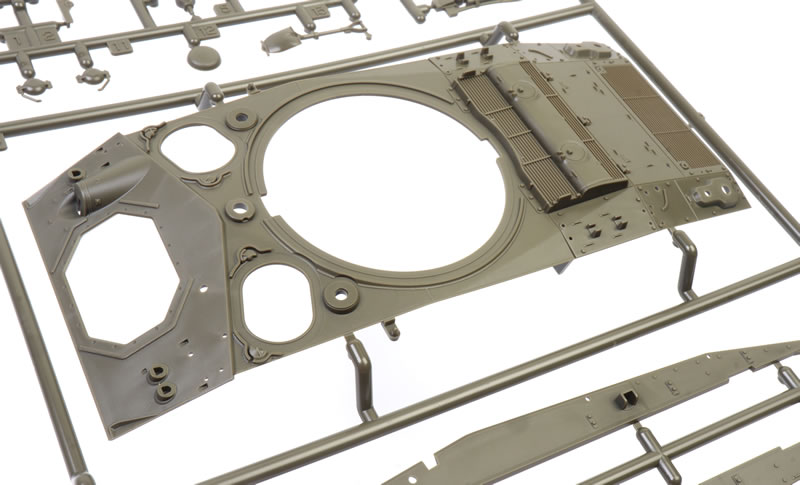




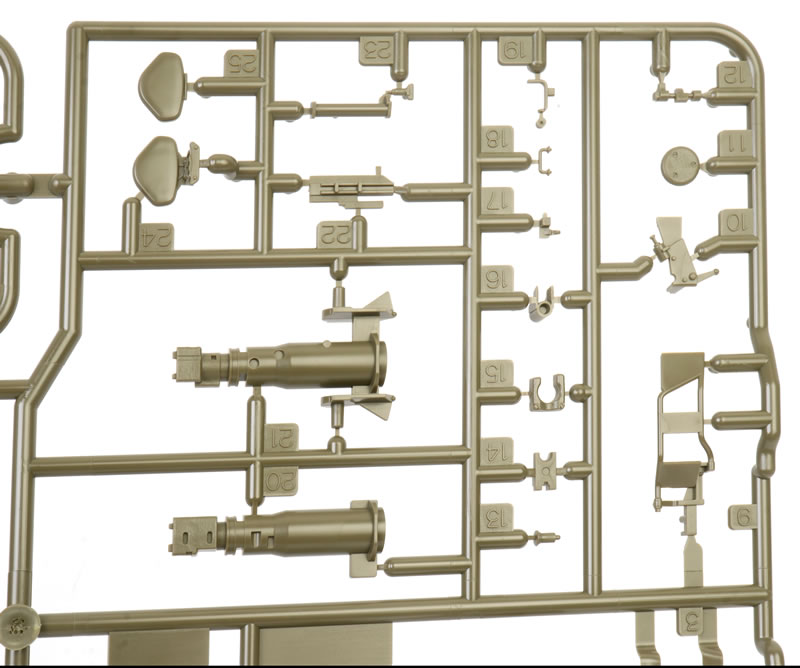
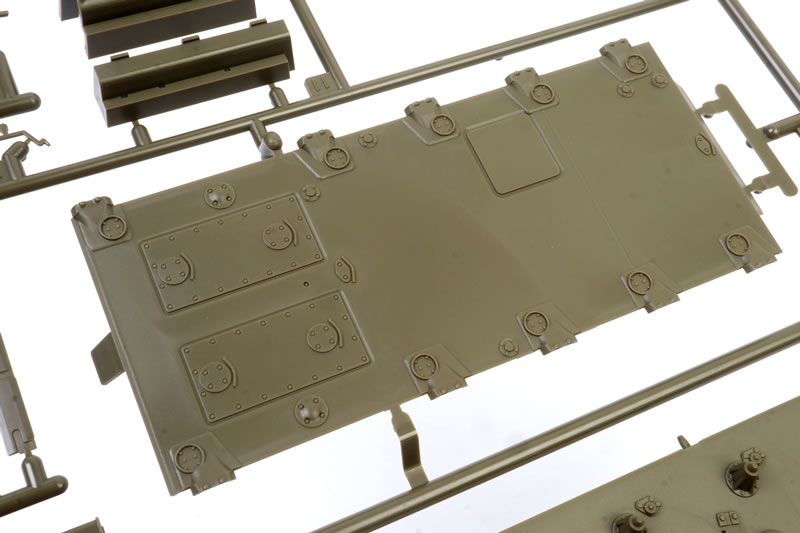



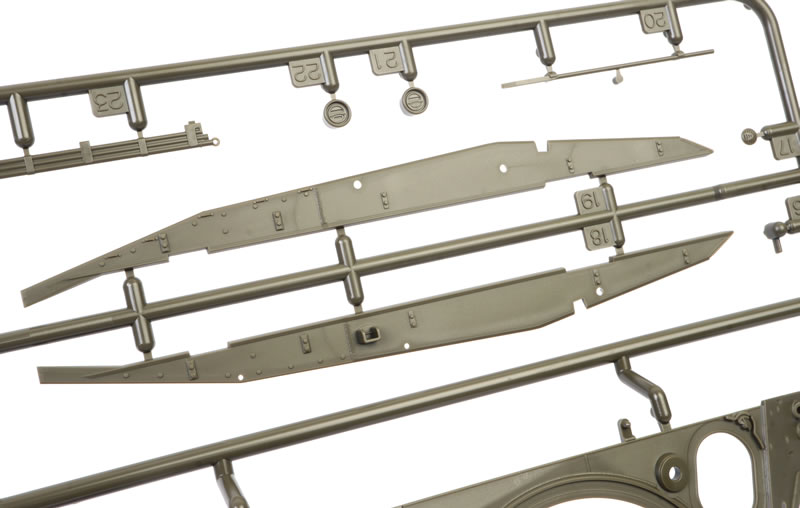


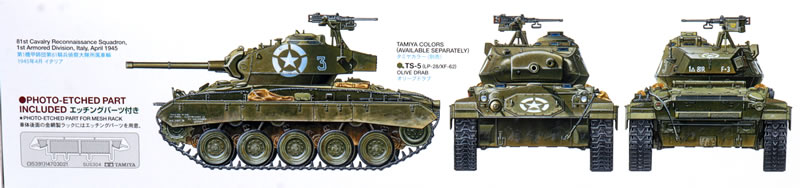


The driver's and radio operator's hatches are separate parts. These are only shown closed in the instructions but there should be no reason why they can’t be posed in the swung-open position.
The lower hull is a flat-pack made up from separate sides, bottom and rear panels.
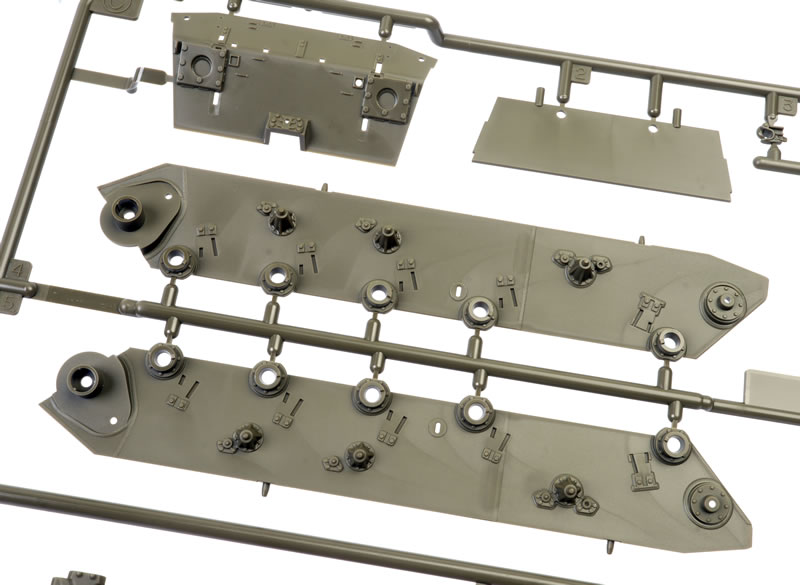
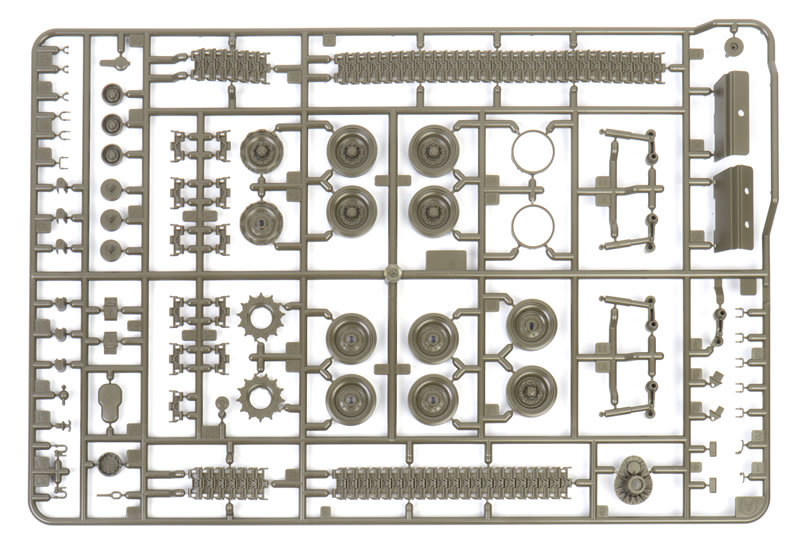
Suspension elements including the axle ends and bumpers are separate parts.
Road wheels are two-part plastic assemblies - no vinyl tyres here. The drive sprockets may rotate after assembly thanks to polythene caps. Track tensioners are separate parts but they are not free to move. They are fixed with notches.
Surface textures are as nice as you would expect from a 21st Century Tamiya offering.
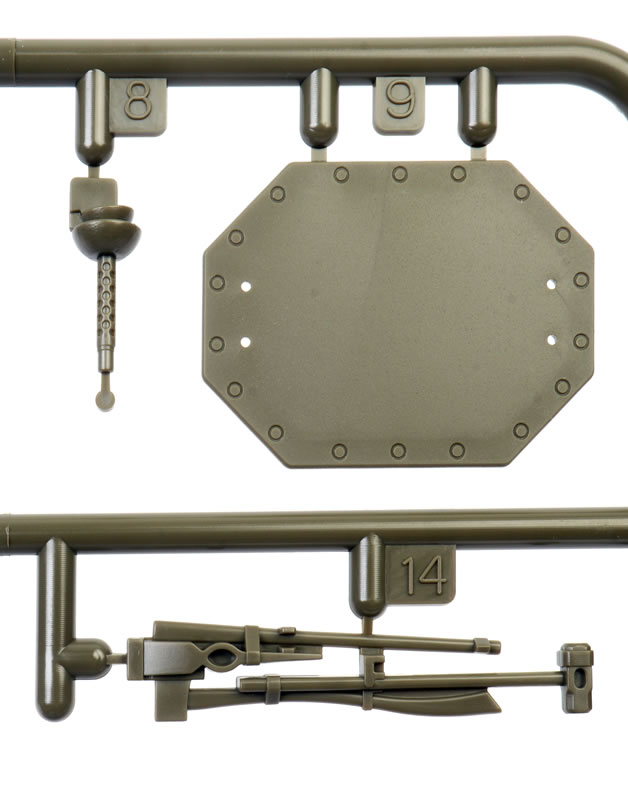
Fine exterior detail is mostly depicted in plastic. Tools are supplies as single parts and bundles of tools moulded in one piece. Brush guards, hand-holds and tie-downs look good.
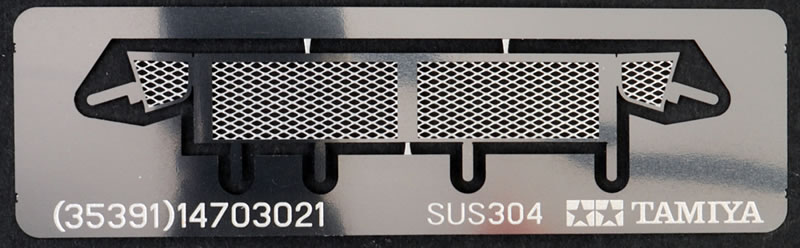
Tamiya provides the rear hull stowage bin as a photo-etched part.
The tow cable is a moulded plastic part.
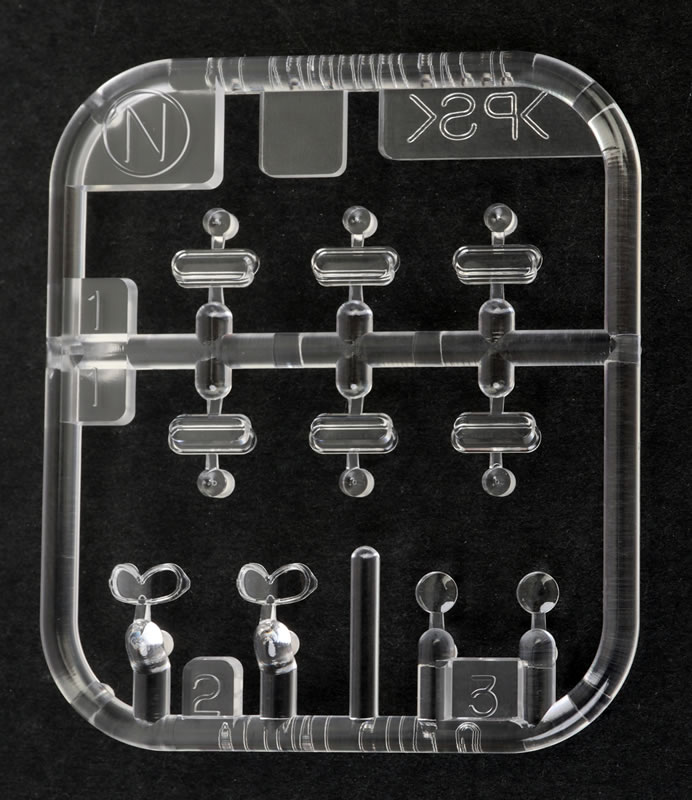
Clear parts are supplied for the light lenses and individual cupola vision blocks - a nice touch. Two sets of crew goggles are also on the clear sprue although you’ll have to make your own straps.
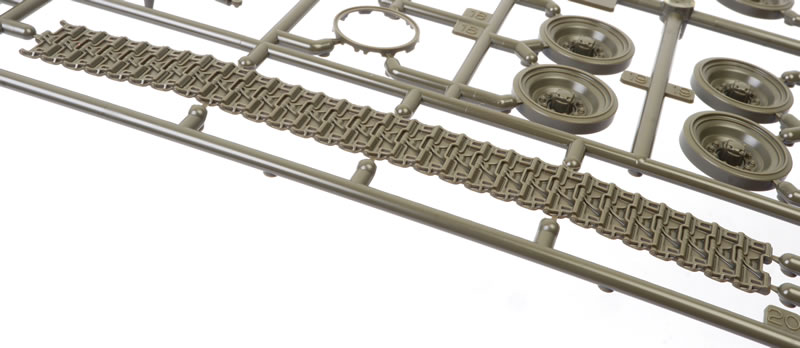
Tracks are link and length with subtle sag along the top run. If recent experience with Tamiya’s tracks are anything to go by, these will be fast and easy to assemble.
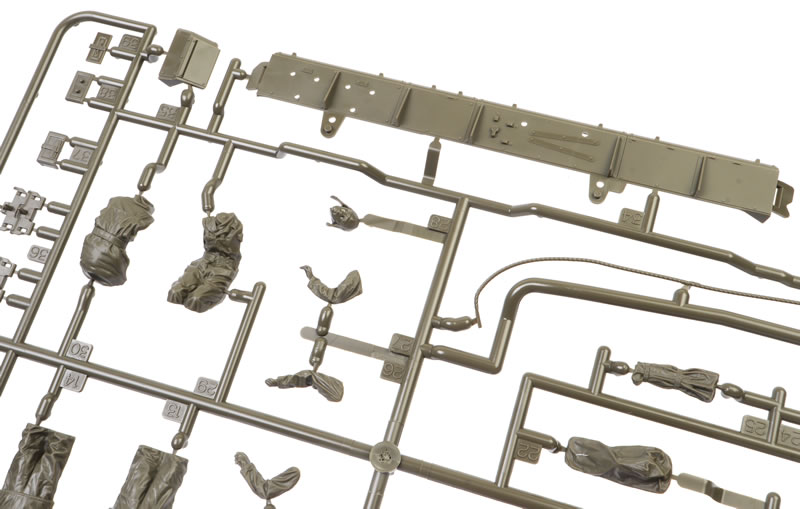
Sand shields are included for two of the three marking options. These are attached via four stout tabs that should deliver a robust fit.
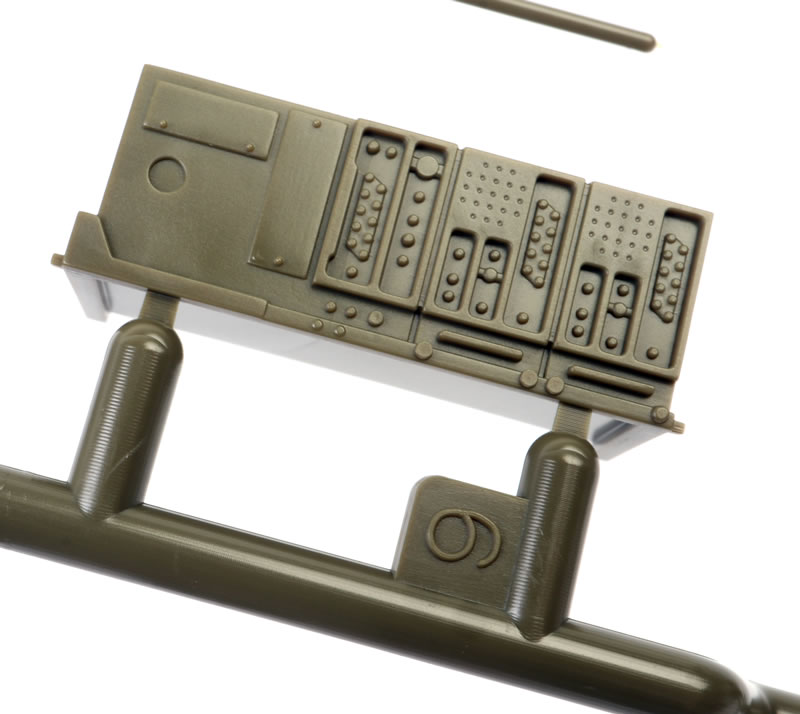
The turret is made up from a base, two sides, a rear and roof panels. The turret will rotate after assembly and the main gun can elevate and depress. Nice breech detail and radio boxes are included.
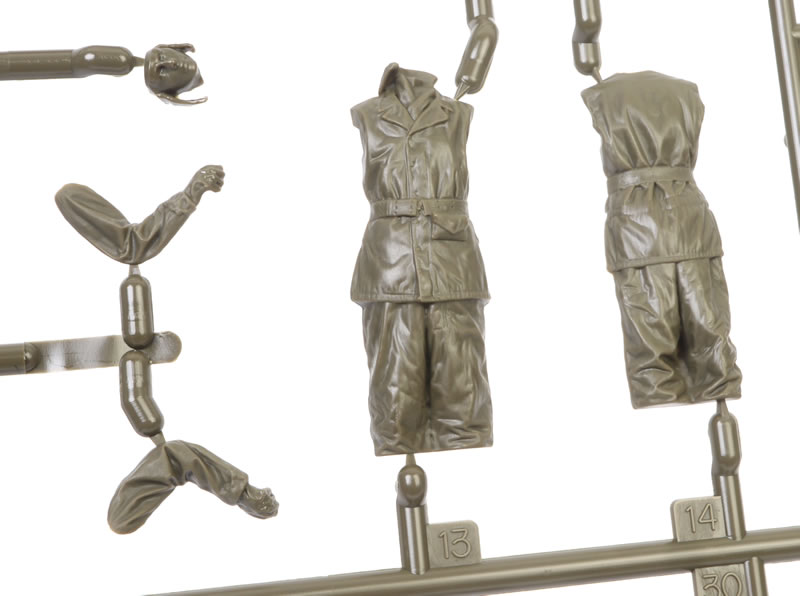
Although we don't get a full action-posed crew with this release, the two supplied torso figures look terrific.
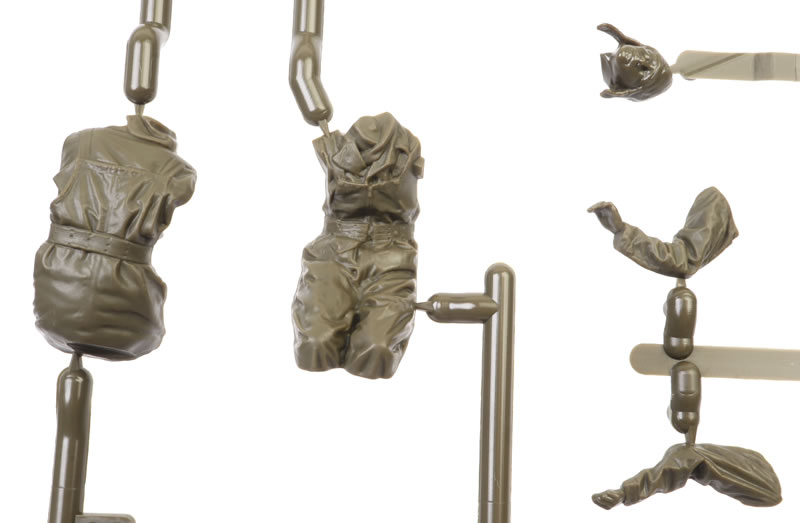
These fit into the turret hatches.
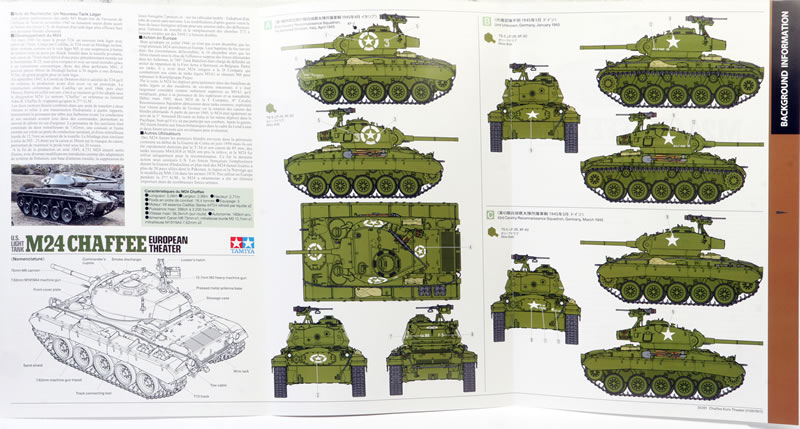
Markings are supplied for three WWII European Theatre vehicles.
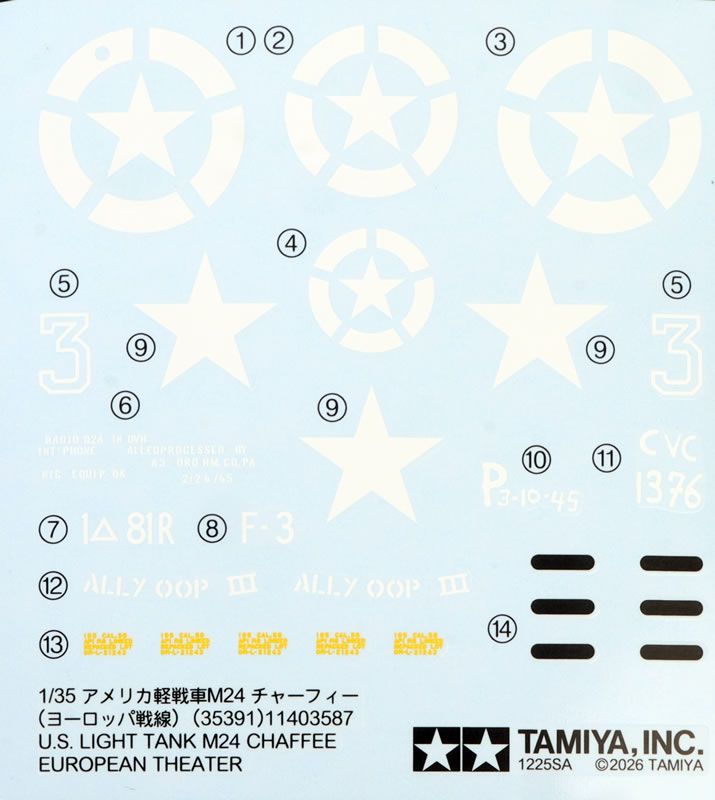
Decals are in perfect register.
C o n c l u s i o n
This new-tool 1:35 scale M24 Chaffee is everything we have come to expect from Tamiya. The kit combines excellent detail, thoughtful engineering and straightforward assembly in a package that should appeal to novice and experienced armour modellers alike.
The model captures the distinctive appearance of the Chaffee, with crisp moulding, subtle surface textures and plenty of detail straight from the box. Features such as the workable gun, rotating turret, detailed breech, clear individual vision blocks and well-sculpted crew figures add extra value, while the link-and-length tracks should offer a good balance between realism and ease of assembly.
The inclusion of a photo-etched rear stowage basket is pleasing to see. Perhaps most importantly, the kit looks like it will be a fast enjoyable build from start to finish, avoiding unnecessary complexity while still delivering a highly detailed replica.
The M24 Chaffee has long deserved a state-of-the-art kit in 1:35 scale and Tamiya has delivered exactly that.
Highly Recommended.
Purchased by the Editor
Tamiya kits are distributed in the UK by The Hobby Company Limited
Home
 Discussion Groups
Gallery
Articles
Reviews
Discussion Groups
Gallery
Articles
Reviews
Copyright
Vendors Room
Links
Contact us
Copyright www.missing-lynx.com 2026
Text and Images by Brett Green
Page Created 31 May, 2026
Page Last Updated
31 May, 2026